
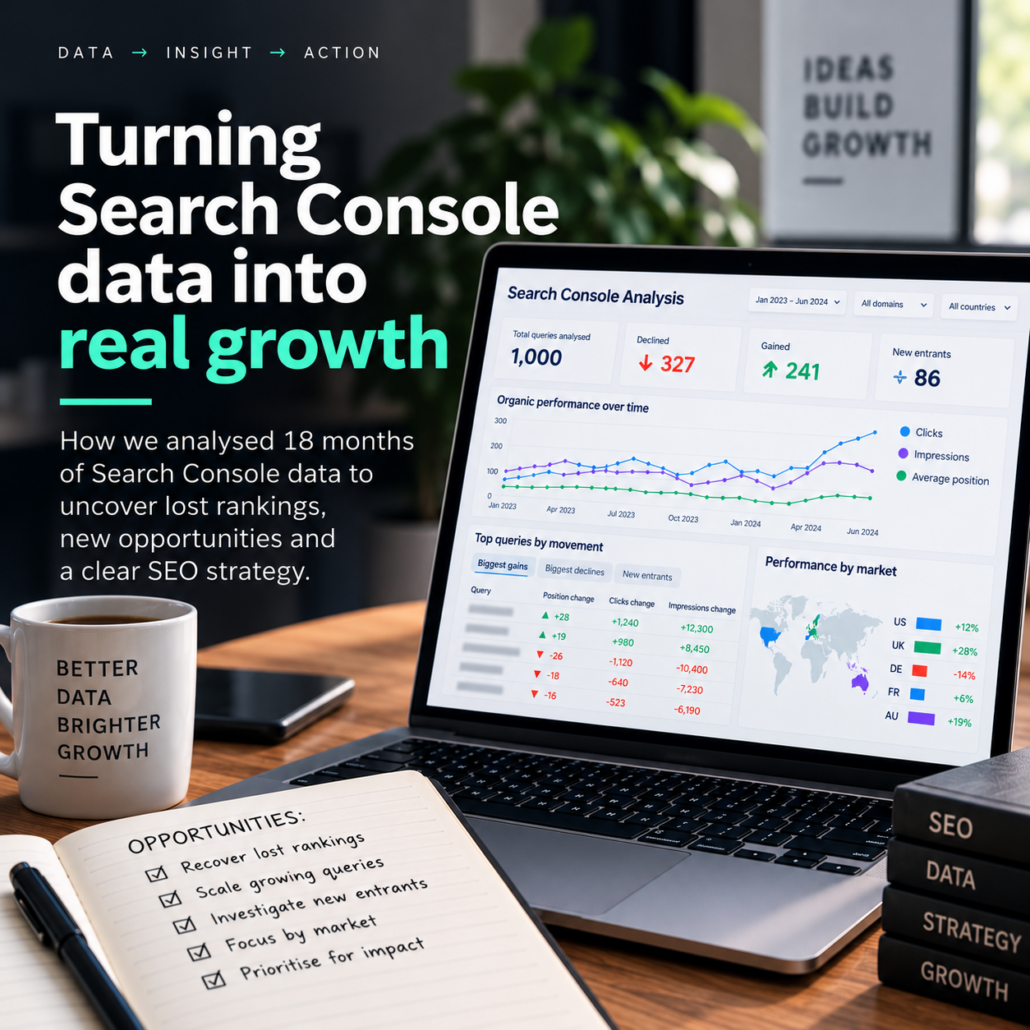

Google Search Console Data Analysis: Finding Hidden SEO Opportunities
Why We Built Our Own Search Performance Analysis Tool Using Google Search Console Data
SEO teams have access to more tools than ever.
SEMrush, Ahrefs and similar platforms are incredibly useful for competitor research, keyword discovery and understanding the wider search landscape.
But sometimes the most valuable search dataset is the one a business already owns.
During a recent client engagement, we needed to understand how organic search performance had changed across three websites, multiple international markets and thousands of individual search queries and landing pages.
We weren’t looking for another high-level SEO visibility score.
We wanted to answer much more specific questions.
What had actually changed over the previous 18 months?
Which important pages had lost visibility? Which search queries had declined? Where were new opportunities emerging? Were particular markets behaving differently? And, most importantly, where should the business focus first to generate the greatest potential commercial impact?
The data existed inside Google Search Console.
The challenge was turning it into something we could use to make decisions.
Going beyond the standard Search Console view
Google Search Console provides an enormous amount of first-party search performance data.
For each website, we can analyse metrics including:
- Search queries
- Landing pages
- Clicks
- Impressions
- Average search position
- Click-through rate
- Countries and markets
- Performance over time
Viewed individually, these metrics are useful.
The real value, however, comes from understanding movement.
For this project, we wanted to analyse the top 1,000 pages and search queries across an 18-month period and determine how their performance was changing.
That meant looking beyond simple month-on-month reporting.
We wanted to identify patterns such as:
Declining queries
Search terms that had historically generated strong visibility or traffic but were progressively losing position, impressions or clicks.
Growing queries
Terms where the websites were gaining visibility and potentially had an opportunity to accelerate that growth.
New entrants
Queries and pages beginning to appear within meaningful search positions that hadn’t previously contributed significant visibility.
Lost opportunities
Terms that had previously performed strongly but had subsequently disappeared or materially declined.
Market differences
Opportunities and problems that weren’t necessarily visible at a global level but became obvious when individual international markets were analysed separately.
Once you start looking at search performance in this way, Search Console becomes much more than an SEO reporting interface.
It becomes a historical dataset describing how Google has responded to your website.
So we built the tool we needed
Rather than manually exporting reports into spreadsheets and repeatedly manipulating the data, we built a lightweight application around the analysis we wanted to perform.
The objective wasn’t to create another SEO software platform.
It was to answer a specific business question quickly.
The application allowed us to take Search Console data and systematically compare performance across different periods, websites, pages, queries and international markets.
Instead of working through thousands of rows manually, we could start categorising movements and surfacing the areas that deserved investigation.
That immediately changed the nature of the strategic review.
Rather than starting with:
“What SEO work should we do?”
We could start with:
“Where has this business lost valuable organic search visibility, where is it gaining visibility, and which opportunities should we investigate first?”
That’s a much better question.
Finding the value hidden inside first-party data
One of the most striking aspects of the exercise was how much useful information was already available.
Businesses frequently invest in additional analytics platforms, SEO subscriptions and reporting tools while substantial amounts of first-party data remain underutilised.
The issue isn’t necessarily access to data.
It’s making the data useful.
A table containing thousands of queries isn’t a strategy.
Neither is a graph showing that organic clicks fell 12%.
We need to understand what caused the movement and where the opportunity exists to change it.
For example, imagine a commercially important query has moved from an average position of 3–4 to position 9–10.
At an aggregate website level, that movement may be almost invisible.
But if the keyword represents a valuable product or service category, recovering those positions could be significantly more valuable than creating dozens of new pieces of content targeting lower-value opportunities.
Equally, a page moving steadily from position 30 to position 12 may represent an emerging opportunity.
It isn’t generating significant traffic yet, so conventional analytics may not draw much attention to it.
But Google is already giving us a signal.
With the right improvements, it may be considerably easier to move that page onto page one than to establish visibility for an entirely new topic.
Prioritising SEO by opportunity rather than activity
This is where the analysis becomes commercially useful.
SEO strategies can easily become lists of activity:
- Produce more content
- Improve metadata
- Build links
- Fix technical issues
- Improve internal linking
- Update category pages
All of those things can be valid.
But they don’t tell us where to start.
Historical search performance gives us another layer of evidence.
If we can identify a cluster of commercially important pages that previously ranked strongly and have subsequently declined, that creates an obvious area for investigation.
We can then ask why.
Has the content become outdated?
Has search intent changed?
Did competitors improve?
Has internal linking changed?
Was the site migrated?
Has Google started favouring a different type of result?
Are there technical problems affecting the page?
Is another page competing for the same query?
The tool doesn’t replace SEO expertise.
It makes it easier to direct that expertise towards the places where it can potentially have the greatest impact.
Why first-party search data matters
Third-party SEO platforms remain extremely valuable.
We use them.
They provide capabilities Search Console doesn’t, particularly around competitor analysis, keyword research, backlink analysis and estimating opportunities outside the existing visibility of a website.
But they’re measuring the search landscape from the outside.
Search Console provides something different: Google’s data about how your website actually appeared in search.
That distinction matters.
For strategic analysis, the two datasets can complement each other.
Search Console can tell us:
This is what happened.
External search datasets can then help us investigate:
Why might it have happened, what are competitors doing, and what opportunities exist beyond our current footprint?
Combined with analytics and commercial data, the picture becomes considerably more powerful.
The bigger opportunity: small software solving valuable problems
There was another lesson from this project that goes beyond SEO.
The application itself didn’t need to become a huge software product.
It simply needed to solve the problem in front of us.
Modern software development — particularly when combined with AI-assisted development, APIs and cloud infrastructure — means businesses can increasingly build highly focused internal tools without embarking on enormous software programmes.
That creates an interesting shift.
Historically, a business might have adapted its process around whatever its existing software allowed it to do.
Increasingly, we can reverse that relationship.
Start with the question.
Then determine whether a relatively small piece of software can help answer it.
In this case:
Data → software → insight → action.
We had a large first-party dataset.
We built software to interrogate it in the way the engagement required.
That surfaced insights.
Those insights could then inform the SEO strategy, target keywords, website priorities and immediate areas of investigation.
From reporting to decision-making
This is ultimately where we think data projects become interesting.
Businesses generally don’t need another dashboard for the sake of having another dashboard.
They need better decisions.
For this engagement, analysing 18 months of Search Console performance gave us a much clearer starting point for understanding three websites across numerous international markets.
It allowed us to move rapidly from a large amount of raw search data towards a much smaller set of questions worth investigating.
And that is exactly what a good strategic review should do.
Not generate more data.
Reduce the number of things you need to think about and make the important opportunities clearer.
At JAS Digital, we increasingly work at the intersection of software development, integrations, data and digital growth. Sometimes that means developing a substantial new business platform. Other times, the highest-value solution can be a focused application that turns data a business already owns into something it can actually act on.
If your business has accumulated data across search, CRM, ecommerce or operational platforms but struggles to turn it into actionable insight, there may be considerably more value sitting inside that data than you realise.
