

The State of AI Development – Q3 2026
Artificial intelligence has moved beyond experimentation.
Over the past 18 months, we’ve seen AI shift from being a useful assistant for writing content and answering questions to becoming an increasingly capable software platform in its own right. Businesses are no longer asking whether they should use AI. They’re asking how to implement it responsibly, securely and in ways that deliver measurable commercial value.
At JAS Digital, AI has become part of almost every project we undertake. However, perhaps surprisingly, very few of those projects are about building “AI products”. Instead, they’re about making existing software dramatically more capable.
This quarter, we’ve been reflecting on how quickly the landscape is evolving and where we believe businesses should focus their attention.
The Conversation Has Changed
A year ago, most discussions centred on large language models.
Today, those models are only one part of a much larger ecosystem.
The conversation has shifted towards:
- AI agents
- Multi-step automation
- Retrieval-Augmented Generation (RAG)
- Structured workflows
- Tool calling
- Knowledge bases
- Long-running tasks
- Secure enterprise integrations
- Human approval and governance
In other words, the challenge is no longer generating text. It’s orchestrating intelligent systems that can reason, retrieve information, use tools and complete meaningful business processes.
AI Is Becoming Part of Your Software Stack
One of the biggest misconceptions we still encounter is the idea that AI should exist as a separate product.
Increasingly, the opposite is true.
The most successful implementations embed AI directly into existing applications.
Rather than opening a separate chatbot, users expect AI to:
- Draft proposals
- Analyse documents
- Summarise meetings
- Generate reports
- Search company knowledge
- Recommend next actions
- Complete repetitive administration
- Assist customer service teams
- Support internal operations
When AI becomes another capability within software rather than the software itself, adoption tends to be significantly higher.
The Rise of AI Agents
Perhaps the most significant development of 2026 has been the maturity of AI agents.
An agent isn’t simply a chatbot.
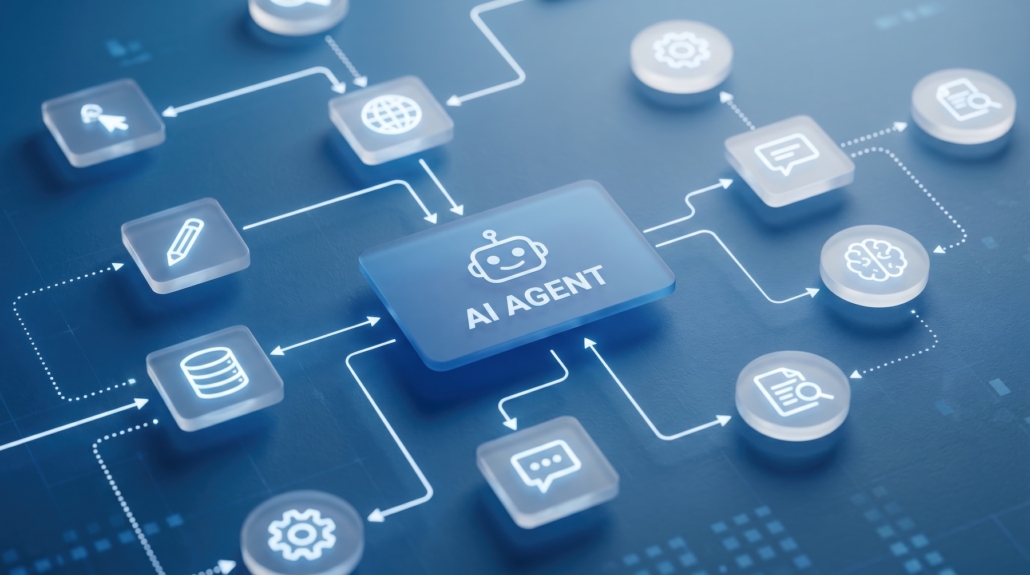
It’s software capable of planning, making decisions within defined boundaries, using tools and completing tasks.
For example, an agent might:
- Monitor incoming enquiries
- Research a prospective customer
- Check internal CRM data
- Draft a personalised response
- Create follow-up tasks
- Notify the sales team
- Escalate exceptions to a human
The important point is that the agent doesn’t replace people.
It removes repetitive coordination work, allowing teams to focus on higher-value decisions.
Context Is the Competitive Advantage
Every major AI model is now highly capable.
The difference between mediocre and exceptional results rarely comes down to the choice of model.
Instead, success depends on context.
AI systems produce dramatically better outcomes when they can access:
- Internal documentation
- Product information
- Customer records
- Policies
- Historical conversations
- Project documentation
- Business rules
This is why we increasingly recommend combining language models with knowledge retrieval and existing business systems.
The AI becomes significantly more useful because it understands your organisation rather than relying solely on general training data.
AI Doesn’t Remove the Need for Software Engineering
If anything, the opposite has happened.
As AI capabilities improve, the importance of good engineering has increased.
Reliable AI systems require:
- Well-designed APIs
- Secure authentication
- Clean data
- Background processing
- Monitoring
- Audit trails
- Permission controls
- Human approval workflows
- Scalable cloud infrastructure
Without these foundations, even the most capable AI model struggles to deliver reliable business outcomes.
Where We’re Applying AI
Across our current projects, AI is helping organisations:
- Automate customer communications
- Generate technical documentation
- Classify and organise large datasets
- Support sales teams with prospect research
- Create marketing content
- Analyse operational information
- Improve search experiences
- Streamline internal administration
- Accelerate software development
The objective isn’t replacing employees.
It’s enabling small teams to achieve significantly more with the same resources.
AI and Software Development
One area that has changed dramatically is software engineering itself.
Modern AI coding assistants can now:
- Generate boilerplate code
- Explain unfamiliar codebases
- Write tests
- Refactor components
- Produce documentation
- Identify bugs
- Suggest architectural improvements
These tools have undoubtedly increased developer productivity.
However, they haven’t eliminated the need for experienced engineers.
In practice, they amplify good developers far more effectively than they replace them.
Architecture, security, user experience, integration design and commercial understanding remain fundamentally human disciplines.
Looking Ahead
Over the next 12 months, we expect several trends to accelerate.
Smaller, More Focused Models
Rather than relying exclusively on enormous general-purpose models, organisations will increasingly deploy specialised models optimised for particular tasks.
AI Embedded Everywhere
Users won’t think about “using AI”.
They’ll simply expect software to be intelligent.
Greater Governance
As AI becomes integrated into critical business processes, transparency, security, compliance and auditability will become increasingly important.
Multi-Agent Systems
Instead of one assistant doing everything, organisations will begin orchestrating multiple specialised agents that collaborate to complete complex workflows.
Human-Centred Automation
The most successful businesses won’t remove people from the process.
They’ll redesign processes so AI handles repetitive work while humans focus on judgement, creativity and customer relationships.
Our Perspective
Technology trends come and go.
Artificial intelligence feels different.
Not because it replaces software development, but because it fundamentally changes what software can do.
For us, AI isn’t another service line.
It’s becoming a capability that sits across everything we build—from customer portals and internal business systems to mobile applications and enterprise platforms.
The organisations seeing the greatest return aren’t chasing every new model or headline.
They’re identifying repetitive, high-value processes, integrating AI into their existing systems and measuring the business outcomes.
That’s where we believe the real opportunity lies.
As we move through the remainder of 2026, we’ll continue helping organisations adopt AI in practical, measurable and sustainable ways—building solutions that complement people, strengthen operations and create long-term competitive advantage.



Leave a Reply
Want to join the discussion?Feel free to contribute!